Most complaints about office cleaning in Pune are not about effort. They are about the same few things slipping: a washroom that is fine at 9 and not at 3, a pantry sink full of cups, meeting rooms nobody resets, glass doors with handprints for weeks. A written checklist fixes that, because it turns "keep the office clean" into specific jobs that can be checked.
This is the kind of checklist we agree in writing with each site before our housekeeping attendants in Pune start. Use it with your own team or with any vendor. Change the frequencies to suit your footfall.
Daily: at opening
These jobs happen before most people arrive, so the office starts the day ready.
- Empty every dustbin and replace liners at workstations, cabins and meeting rooms.
- Dust desks, monitor stands, phones and cabinet tops (not keyboards or papers unless agreed).
- Sweep and wet-mop all hard floors; vacuum carpeted areas.
- Clean and disinfect washrooms fully: WCs, urinals, basins, mirrors, floors, and refill soap, tissue and hand towels.
- Wipe the pantry counter, sink, microwave and fridge handles; clean the floor.
- Clean the reception desk, visitor seating and the main entrance glass at hand height.
- Wipe lift buttons, door handles, push plates and stair rails.
Daily: rounds during the day
This is the part most offices leave out, and the part people notice most. A two-floor office with one attendant per floor can usually run a full round every hour or two.
- Check every washroom on a fixed round, at least every one to two hours, and sign the washroom log.
- Reset meeting rooms after each use: wipe tables, clear cups and bottles, straighten chairs.
- Keep the pantry usable: clear the sink, wipe spills, empty the wet-waste bin when full.
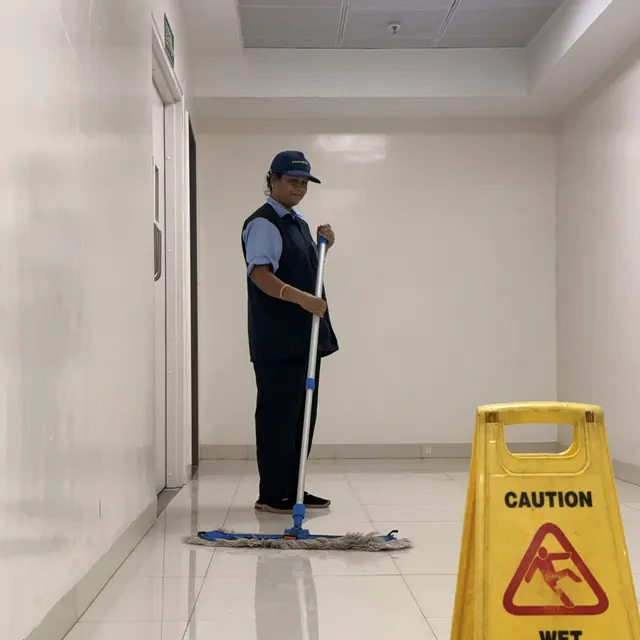
- Spot-mop spills straight away and put out a wet-floor sign.
- Restock consumables before they run out, not after someone complains.
Daily: at closing
- Final washroom clean and restock.
- Empty all bins and take segregated waste to the collection point.
- Wash and dry pantry utensils, wipe appliances, leave the sink empty.
- Switch off pantry appliances as agreed, and report anything broken.
- Hand over to the next shift, or note issues in the site register.
Weekly
Weekly tasks stop slow build-up: limescale, grime on chair bases, dust on ledges. Put them on fixed days so they do not get pushed back.
- Damp-wipe chair arms and bases, partitions and cabinet fronts.
- Clean all internal glass doors and partitions fully, not just at hand height.
- Descale washroom taps, basins and urinals; deep-clean grout lines.
- Clean the inside of the pantry fridge and microwave and throw out expired items (with the office's agreement).
- Dust skirting, window sills, ledges and the tops of door frames.
- Wash dustbins, inside and out.
- Machine-scrub hard floors in high-traffic areas, where the site has a machine.
Monthly
Monthly tasks need more time, sometimes a ladder or a machine, and often a quieter day such as a Saturday.
- Clean light fittings, AC grilles and exhaust fan covers (from a safe ladder, power off where needed).
- Wash internal windows and window channels.
- Deep-clean carpets or shampoo high-traffic patches, if agreed.
- Clean behind and under movable furniture and pantry appliances.
- Check and clean fire-exit routes and the staircase from top to bottom.
- Review the checklist with the office admin: what is missed, what can drop, what needs adding.
How to make a checklist actually work
Give every line an owner and a time
"Clean washrooms" is not a task. "Washroom round, ground floor, every 90 minutes, initials on the door log" is. When the checklist names who and when, you can check it in under a minute.
Put a log where the work happens
A simple sheet on the inside of each washroom door, with times and initials, does more than any app. Visitors see that it is checked; staff know that someone looks.
Sign it off on site every week
Someone from the cleaning side should walk the office with your admin or facility person every week, look at the logs and agree what needs fixing. Under the Rayat Standard our supervisor does this on every site, every week.
Size the team to the checklist, not the other way round
Write the checklist first, then estimate the hours it needs. If the daily rounds alone fill one person's day, a single attendant cannot also do the weekly glass and the pantry. Remember that every person on the rota must be paid at least the current Maharashtra minimum wage, and longer days mean overtime. Our housekeeping cost calculator shows what each extra person or extra hour costs, and our worked example for a 60-seat office shows a typical team.
Agree consumables in writing
Decide who supplies chemicals, liners, soap, tissue and machines, and how restocking is triggered. Many "cleaning" complaints are really "we ran out of hand towels" complaints.
If you would like us to turn this list into a checklist for your own floors, build a short site brief and Nikhil will send back a draft. For warehouses and factory floors, where the work is closer to shop-floor support, see manpower supply.
Pantry and tea service
If your office runs tea and coffee rounds, washes cups or sets up meeting rooms for clients, that is a separate job from cleaning. Combining it with a housekeeping attendant's checklist usually means one of the two suffers at 11 am. Many offices give it to a dedicated pantry attendant. See our office and pantry staff page for what that role covers.
Safety basics that belong on every checklist
- Wet-floor signs out whenever a floor is wet, and taken in once it is dry.
- Chemicals kept labelled, in their own cupboard, never in pantry bottles.
- Gloves for washrooms and waste; separate cloths for washrooms and pantry, colour-coded.
- No standing on chairs; a proper step ladder for high dusting.
- Electrical fixtures cleaned only with power off, and faults reported, not fixed by the attendant. Routine repairs are a job for maintenance technicians.
For more practical notes like this one, browse the Rayat guides or try our free planning tools.